
Close Menu
  • BECOME A MEMBER
  • ABOUT GEOPOLITICS & EMPIRE
  • PODCAST
  • ANALYSIS
  • DONATE / SUPPORT
  • CONSULTATION
  • SPONSORS
What's Hot

John Helmer: US Empire, Iran, Russian Oligarchy, Permanent War, & Whither Multipolarity?

April 11, 2026

GAE’s Weekly Headlines & Commentary

April 11, 2026

Christian White Podcast: Globalist Endgame, Digital Concentration Camps, Kayfabe

April 9, 2026
Substack X (Twitter) Telegram Apple YouTube RSS
X (Twitter) Telegram Substack SoundCloud Apple YouTube Odysee Facebook LinkedIn RSS
Geopolitics & Empire
BECOME A MEMBER
  • ABOUT
    • ABOUT GEOPOLITICS & EMPIRE
    • GEOPOLITICS & EMPIRE PODCAST REVIEWS
    • AUTHORS
    • CONTACT
    • MEDIA APPEARANCES
    • FAQ
  • PODCAST

    John Helmer: US Empire, Iran, Russian Oligarchy, Permanent War, & Whither Multipolarity?

    April 11, 2026

    Bob Moriarty: Biggest Tipping Point in 500 Years, Collapse of Petrodollar & US Empire

    April 8, 2026

    Pastor Billy Crone: On the Cusp of World Government via 10 Regional Unions

    April 6, 2026

    Jeffrey Peel: Exercise Pegasus & Iran as Catalyst for Technocratic Multipolar Reset

    April 5, 2026

    Gilbert Doctorow: Pressure on Putin, Iran Shock, Chinese Cowardice, & Death of NATO?

    March 31, 2026
  • ANALYSIS

    Multipolarity As World Government 3.0 & Its Pied Pipers

    March 23, 2026

    Dr. Francis Boyle Has Passed

    February 1, 2025

    Stars & Stripes Globalism: Donald Trump’s Plan for a New World Order

    January 20, 2025

    Russia & Iran: Axis of the Impotent

    August 22, 2024

    Lifting the Veil on Russia’s SMO in Ukraine: Is Putin’s Response to NATO’s Provocations a Potemkin Village?

    August 14, 2024
  • DONATE/SUPPORT
  • CONSULTATION
  • SPONSORS
  • ESPAÑOL
Geopolitics & Empire
Home»Analysis»Armenia: Between the Hammer & the Anvil
Analysis

Armenia: Between the Hammer & the Anvil

Nikola MikovicBy Nikola MikovicMay 4, 2023No Comments5 Mins Read
Twitter Telegram LinkedIn Facebook Email
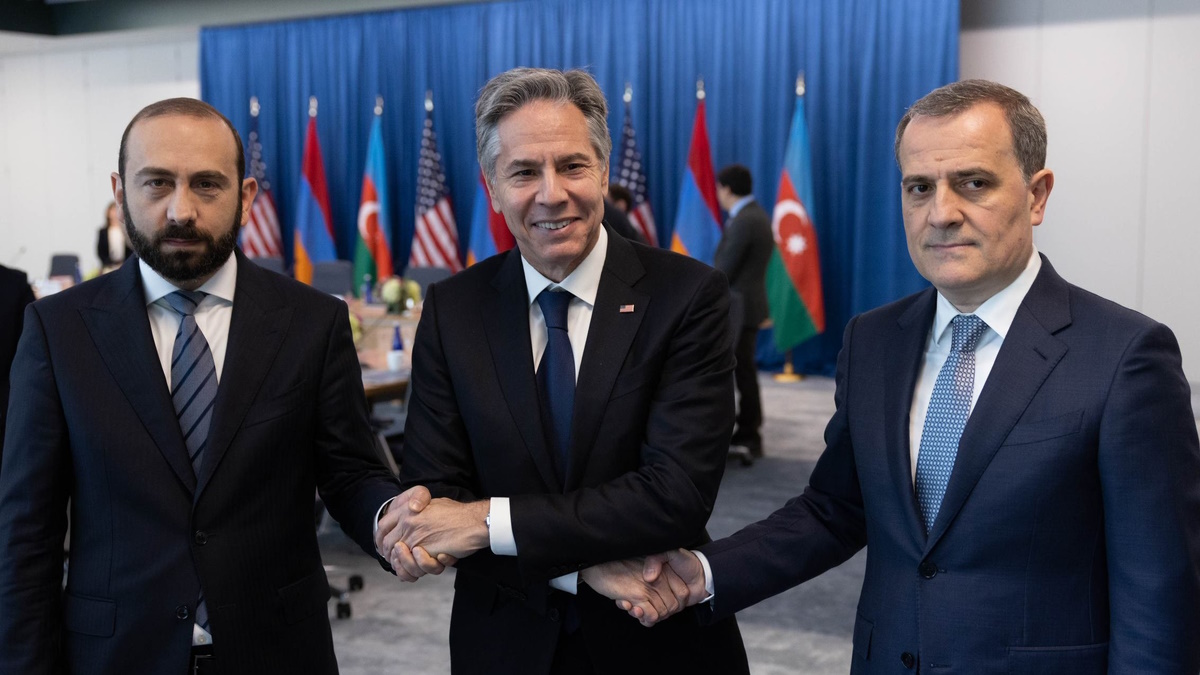
Photo: https://twitter.com/SecBlinken/status/1653124890084401153
Share
Twitter Telegram LinkedIn Facebook Email

While Russia remains bogged down in Ukraine, the United States seeks to increase its influence in the South Caucasus – a region that has traditionally been in Moscow’s geopolitical orbit. This week the US hosted negotiations between Armenia and Azerbaijan, seeking to quell recent tension over Nagorno-Karabakh that threatens to once again destabilize the turbulent region.

On April 23 Azerbaijan announced it had set up a checkpoint on the Lachin corridor, the only land link between Armenia and Nagorno-Karabakh – a mountainous region internationally recognized as part of Azerbaijan, although it has been under the Armenian control for three decades. Such an action marked the end of the months-long Azerbaijani blockade of the transportation route. But even though the energy rich Caucasus nation restored control over its entire border with Armenia, that does not necessarily mean that the transportation network in Nagorno-Karabakh will remain passable.

On May 2, Karabakh Armenians set up tents on the Stepanakert-Shusha road and launched an indefinite protest, demanding Azerbaijan to remove the checkpoint. In other words, the Armenians are now attempting to use Azerbaijani strategy hoping to achieve their goals by blocking the road. But given that Armenia’s Prime Minister Nikol Pashinyan recently stressed that his country “fully recognizes territorial integrity of Azerbaijan”, and that not a single major global actor condemned Baku’s actions on the Lachin corridor, it is extremely unlikely that Azerbaijani military will remove the checkpoint.

The US Secretary of State Antony Blinken expressed Washington’s “deep concern” that Azerbaijan’s establishment of a checkpoint on the Lachin corridor “undermines efforts to establish confidence in the peace process”. Such a statement perfectly illustrates that Baku got at least a tacit approval from the US to restore control over its border with Armenia. More importantly, the very fact that the Russian peacekeepers – who have been deployed to Nagorno-Karabakh following the 44-day war Armenia and Azerbaijan fought in 2020 – did not even attempt to prevent Azerbaijan from setting up a checkpoint, suggests that Moscow also indirectly greenlit Baku’s actions.

Thus, Karabakh Armenians seem to be on their own. Now that Azerbaijan effectively controls the entrance to Nagorno-Karabakh, Armenia will no longer be in a position to supply the self-proclaimed Republic of Artsakh (Artsakh being the Armenian name for Nagorno-Karabakh) with weapons. Moreover, in order to cross the border, Baku may eventually require the local Armenians to get Azerbaijani passports, which will be the first step in a long-term process of their integration into Azerbaijani society.

Meanwhile, the US will likely attempt to benefit from the tense situation in the region, and start playing the role of a major mediator in the decades-old conflict between the two former Soviet republics. At this point, it is not very probable that Armenian and Azerbaijani leaders will sign a potential US-brokered peace deal in the near future, although Washington will undoubtedly pressure Yerevan and Baku “normalize relations” as soon as possible. But how will that affect Russia’s positions in the South Caucasus?

Hosting peace talks this week with Foreign Minister @AraratMirzoyan and Foreign Minister @Bayramov_Jeyhun at our new facility at the George P. Schultz National Foreign Affairs Training Center. Dialogue is key to reaching a lasting peace in the South Caucasus region. pic.twitter.com/LGYEkcq3ig

— Secretary Antony Blinken (@SecBlinken) May 1, 2023

For the Kremlin, “there is no alternative” to a deal that Moscow signed with the two warring countries in 2020. Even though the Russian-brokered ceasefire agreement effectively ended the Second Karabakh War, to this day border clashes between Azerbaijan and Armenia remain a norm. Since Moscow, following several Azerbaijan’s incursions into Armenian territory, refused to protect its ally Armenia, anti-Russian sentiment in the landlocked country of around three million people started to grow.

That, however, does not man that Armenia will leave the Russian-dominated Collective Security Treaty Organization anytime soon, although Yerevan will likely seek to establish close ties with the West, as well as with Iran, hoping that such a strategy will help the former Soviet republic protect its national interests. As a result, Russia will continue losing its influence in the region. Washington, for its part, is “optimistic that peace and stability between Armenia and Azerbaijan can be achieved”. But in order to reach a peace deal, Baku is expected to pressure Yerevan to build its section of the Nakhchivan corridor (also known as Zangezur corridor) – linking mainland Azerbaijan with its exclave of Nakhchivan through Armenian territory – with no passport or customs controls.

Since Armenia has de facto given up its aspirations to preserve control over Nagorno-Karabakh, it has lost the last trump-card it could have used against Azerbaijan. Once Baku resolves the Karabakh issue in its favor – one way or another – Yerevan will be forced to make new concessions to its neighbor. After the Lachin corridor crisis is over, the Nakhchivan corridor crisis will break out, and Armenia will have a hard time preserving its sovereignty in the southernmost province of Syunik, where the new transportation route is expected to be built.

In order to prevent such an outcome, Yerevan will continue distancing itself from the Kremlin, and attempting to develop close ties with Washington, although there is no guarantee that the United States – even if it manages to eventually crowd Russia out of the Caucasus – will ever take a pro-Armenian stance and turn its back on energy-rich Azerbaijan.

Armenia Azerbaijan Iran Russia
Share. Twitter Telegram LinkedIn Facebook Email
Previous ArticleIs the War in Syria Finally Coming to an End?
Next Article The Curious Case of Russo-Turkish Rapprochement
Nikola Mikovic
  • Website
  • X (Twitter)

Nikola Mikovic is a freelance journalist, researcher and analyst based in Serbia. His work focuses mostly on the foreign policies of Russia, Belarus and Ukraine. His area of focus is the ongoing conflict in the Donbass, as well as relations between Russia and former Soviet republics. Nikola also covers Russia's involvement in Syria and Libya. He writes for several publications such as Diplomatic Courier, Asia Times, CGTN, Tsarizm, Global Comment, among others.

Related Posts

John Helmer: US Empire, Iran, Russian Oligarchy, Permanent War, & Whither Multipolarity?

April 11, 2026

Bob Moriarty: Biggest Tipping Point in 500 Years, Collapse of Petrodollar & US Empire

April 8, 2026

Jeffrey Peel: Exercise Pegasus & Iran as Catalyst for Technocratic Multipolar Reset

April 5, 2026

Riley Waggaman: Kicked Out of Russia for Realizing Multipolar BRICS is WEF Carbon Copy?

March 30, 2026

Comments are closed.

Substack

Social Media
  • X (Twitter)
  • Telegram
  • Spreaker
  • Apple
  • YouTube
  • Odysee
  • BitChute
  • Rumble
  • LinkedIn
  • Facebook
  • Instagram
  • Gab
Recent Posts
Podcast

John Helmer: US Empire, Iran, Russian Oligarchy, Permanent War, & Whither Multipolarity?

By Geopolitics & EmpireApril 11, 20260

Veteran foreign correspondent and journalist John Helmer discusses propaganda today, how the U.S. Empire is…

GAE’s Weekly Headlines & Commentary

April 11, 2026

Christian White Podcast: Globalist Endgame, Digital Concentration Camps, Kayfabe

April 9, 2026

Reality Check Radio: Will the Iran War Lead to Global Energy Control?

April 8, 2026
About
About

The Geopolitics & Empire Podcast conducts interviews with prominent international experts on a wide-range of topics. The broadcast seeks to gain insight from guests who come from the left, right, and beyond. The host does not always agree with beliefs espoused by podcast invitees, but maintains an open mind, and believes it important to respectfully listen to a multitude of voices and let listeners come to their own conclusions.

Top Headlines

John Helmer: US Empire, Iran, Russian Oligarchy, Permanent War, & Whither Multipolarity?

April 11, 2026

GAE’s Weekly Headlines & Commentary

April 11, 2026

Christian White Podcast: Globalist Endgame, Digital Concentration Camps, Kayfabe

April 9, 2026
Site Map
  • About Geopolitics & Empire
  • Geopolitics & Empire Podcast Reviews
  • Podcast
  • Analysis
  • Donate / Support
  • Consultation
  • Become a Member
  • Sponsors
  • FAQ
  • Contact
Substack X (Twitter) Telegram SoundCloud Apple Spotify YouTube Odysee Rumble BitChute Brighteon VK Gab MeWe Minds LinkedIn Facebook Instagram RSS
© 2015 - 2026 Geopolitics & Empire. Web Design by Etailing. Domains by easyDNS. Hosting by EuroVPS.

Type above and press Enter to search. Press Esc to cancel.

Sign In or Register

Welcome Back!

Login to your account below.

Lost password?